19.8 Million Tourists, Half the Businesses Invisible Online.
Morocco confirmed 19.8 million international visitors in 2025. Africa's most visited country for the second year running. Its visitors book online, research on Google, and choose based on what they can find. A large share of Moroccan businesses are not findable. Here is what that means for companies entering the market.
In our previous post, we wrote about a statistic buried in ANRT's annual domain observatory: just 51% of Morocco's registered .ma domains have an active website behind them. The other half claimed space online and built nothing. We were looking at that figure as a story about Moroccan SMEs and digital adoption. Then we looked at the tourism numbers, and the same gap became something more urgent.
Morocco welcomed 17.4 million international visitors in 2024 — overtaking Egypt to become Africa's most visited country for the first time. In 2025, it confirmed that position with 19.8 million arrivals, ahead of Egypt's 19 million, and well above the government's own target of 18 million. Those visitors arrived with digital expectations built over years of booking on Expedia, researching on TripAdvisor, and navigating on Google Maps. A significant share of the businesses they were looking for were not there to be found.
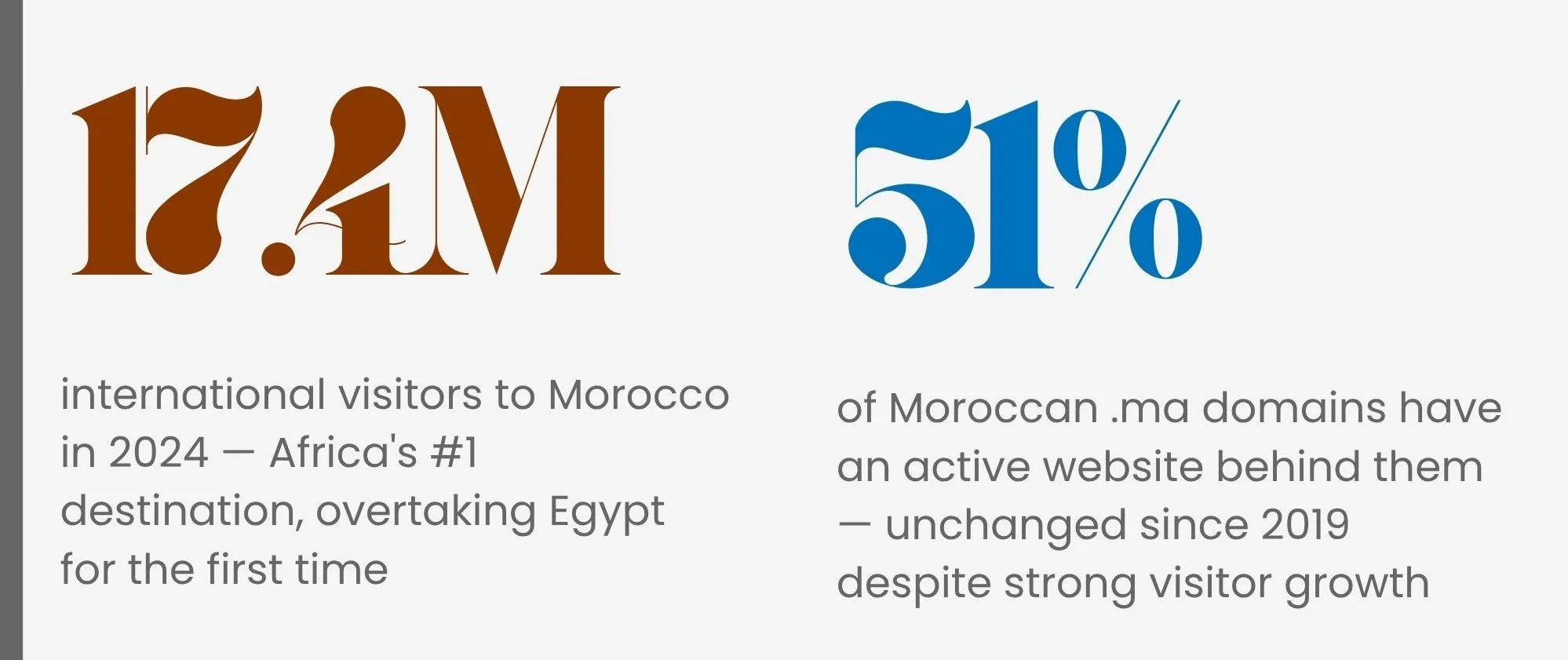
These two figures do not live in separate conversations. They define the same market condition: Morocco is internationally attractive, increasingly so, and digitally under-indexed at the business level. For companies evaluating Morocco as a market to enter or operate in, this gap is both a risk and a signal.
The scale of tourism growth
Morocco's tourism trajectory is not a post-pandemic bounce. It is structural. Tourism-related GDP grew 38.4% between 2019 and 2024, and the sector now contributes 7.3% of national GDP — outperforming most other strategic sectors. Revenue from international visitors reached USD 12.4 billion in 2024, a 43% increase on 2019.
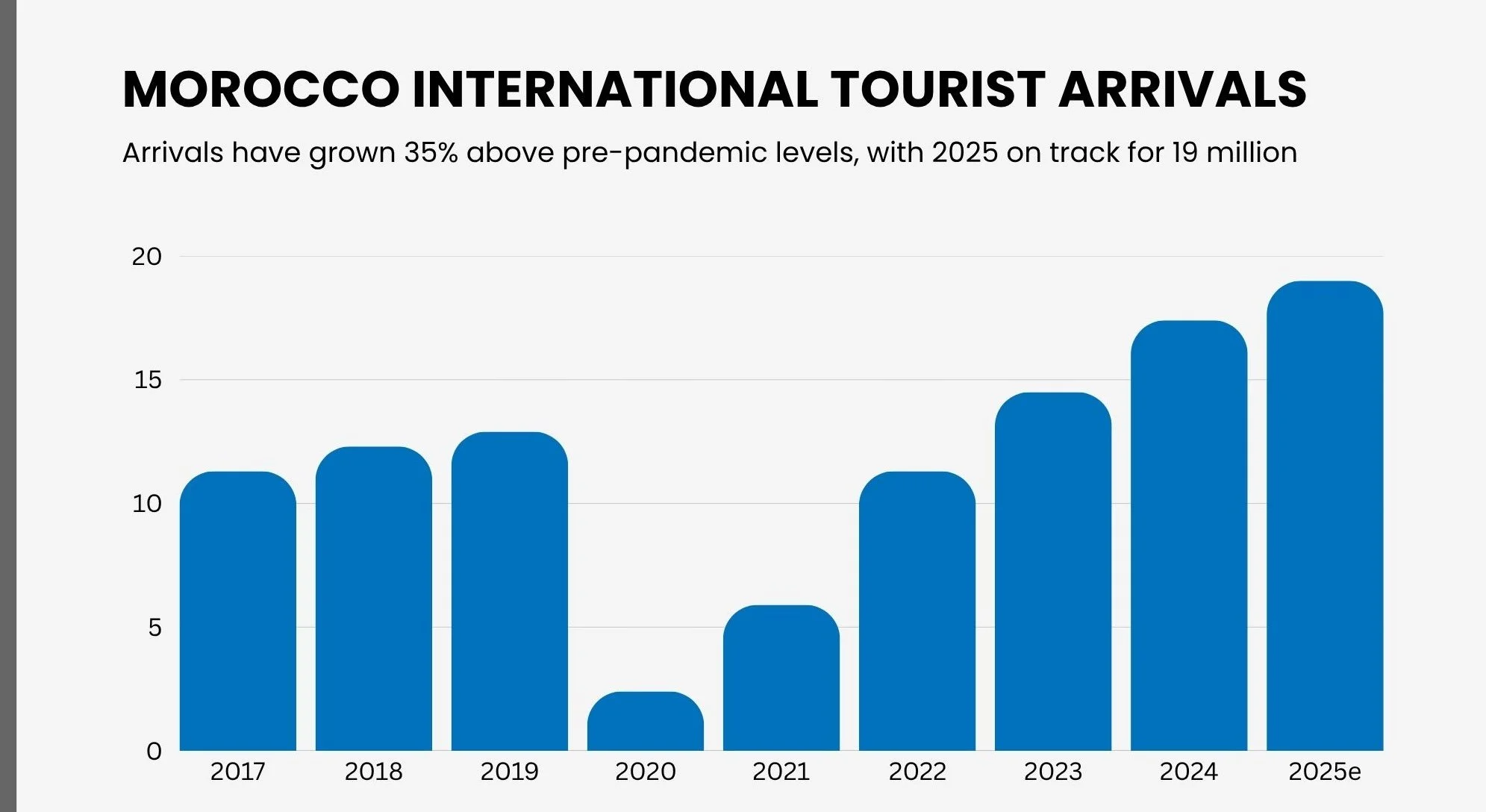
Sources: UN Tourism, Ecofin Agency, Morocco Ministry of Tourism 2025
The geographic spread is also widening. France remains the largest source market, but British, Gulf, and North American arrivals are growing faster. Morocco's tourism strategy through 2030 explicitly targets diversification away from seasonal, price-sensitive European visitors toward higher-spending, longer-staying international travellers, precisely the segment most likely to rely on digital research before and during a trip.
The government target is 26 million visitors by 2030, aligned with the FIFA World Cup co-hosting role. That is not a forecast. It is a floor, given current trajectory.
What digitally-native tourists actually do
Understanding the gap requires understanding how modern international tourists behave before they arrive. The research phase is entirely digital: destination shortlisting on Instagram and YouTube, accommodation comparison on Booking.com and Airbnb, restaurant and activity discovery on Google Maps and TripAdvisor, itinerary building through blogs and travel forums. By the time a visitor from London, Paris, or Riyadh lands in Casablanca or Marrakech, they have already made most of their spending decisions based on what they found (or did not find) online.
What gets found gets chosen
A restaurant with no website, no Google Business profile, and no presence on booking platforms is invisible to this research process — regardless of how good the food is. A riad that appears on one photo-sharing platform but has no direct booking capability loses revenue to the OTA that charges 20–25% commission. A local guide service that relies entirely on physical referrals at the airport captures none of the pre-trip booking that higher-margin international visitors increasingly prefer. The digital gap is not an inconvenience. It is a revenue allocation mechanism, and it systematically routes spend toward businesses that are findable.
Online sales are projected to account for 83% of total travel and tourism revenue in Morocco by 2030.That projection does not describe a distant future. It describes the direction of every booking made by the visitors already arriving today.
Morocco's position among African tourism markets
The comparison with peer markets sharpens the picture further. Morocco's rise to the top of African tourism is recent but decisive — and it is happening in a context where each major market has a distinct digital profile.
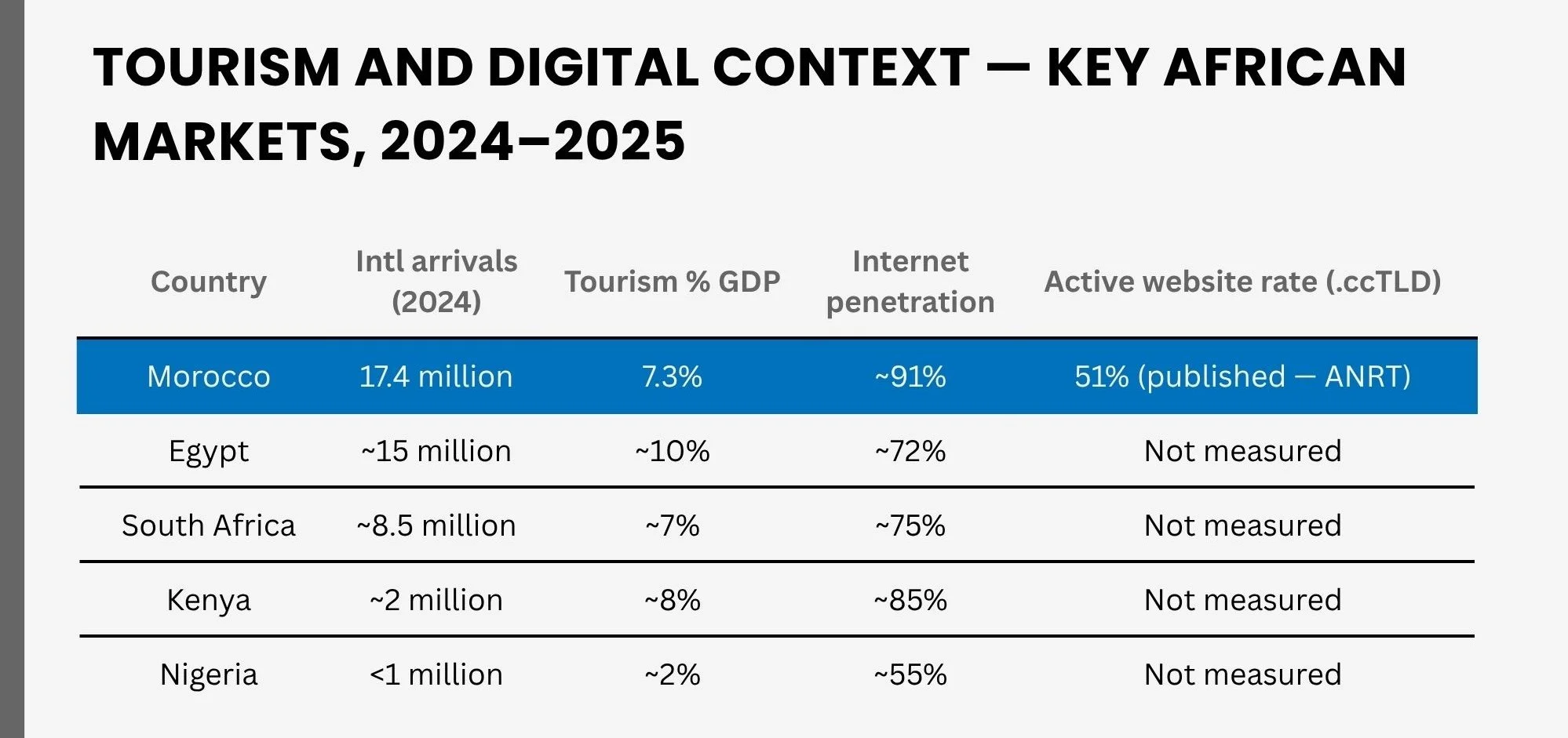
Morocco has the highest internet penetration in Africa (~91%) but only 51% of .ma domains have an active site.
Morocco's internet penetration rate, the highest on the continent at approximately 91%, means the infrastructure for digital commerce is in place. The constraint is not connectivity. It is activation: converting that infrastructure into working business presence. No other African registry publishes an active website rate equivalent, but the combination of Morocco's high penetration and its 51% activation figure suggests the gap between access and use is wider here than headline internet numbers imply.
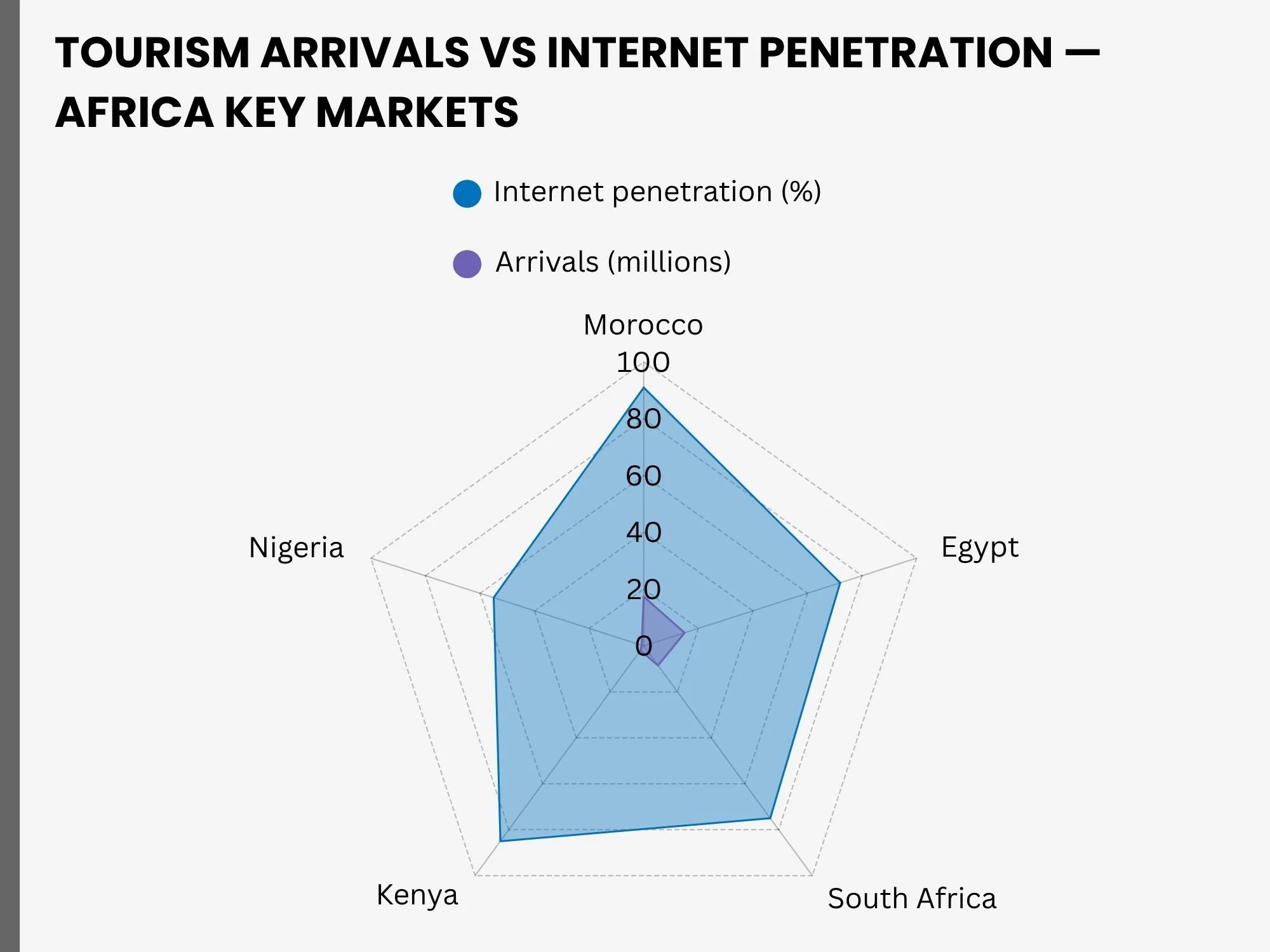
Sources: UN Tourism, ANRT, ITU, DataReportal 2024
What this means for companies entering Morocco
For international companies evaluating Morocco as a market, whether as a destination for investment, a supply chain partner, or a location for regional operations, the tourism-digital gap communicates something specific about the current state of the business environment.
Morocco is not digitally immature. It has infrastructure, regulation, and government ambition that exceeds most peer markets. The Digital Morocco 2030 plan commits USD 1.1 billion to technology infrastructure. The country has 5G, fibre in major cities, and a young population that is digitally fluent as consumers.
What it lacks, at the SME level, is the translation layer, the operational capacity to turn that infrastructure into business-facing digital presence. This creates a specific market condition: strong consumer-side digital adoption, underdeveloped business-side digital infrastructure. The tourists are arriving and looking. A large share of the businesses they are looking for are not there.
The implication for market entry
A foreign company entering Morocco with a well-structured digital presence — multilingual, mobile-optimised, with working contact and booking infrastructure — starts with a structural advantage over a significant share of existing local businesses. That is not a permanent advantage; the gap will close. But it closes faster in sectors where international visitors are already creating demand for discoverable, bookable, reviewable services. Hospitality, healthcare, professional services, and food are the immediate examples. The window is not indefinite.
Tourism revenue and the 2030 trajectory
The numbers compound. In the first ten months of 2025 alone, Morocco's tourism revenues reached USD 11.3 billion — already surpassing the entirety of 2024. The government target of 26 million visitors by 2030 implies a further 50% increase from the current base, driven by the World Cup co-hosting infrastructure investment cycle and the explicit diversification strategy toward higher-spending markets.
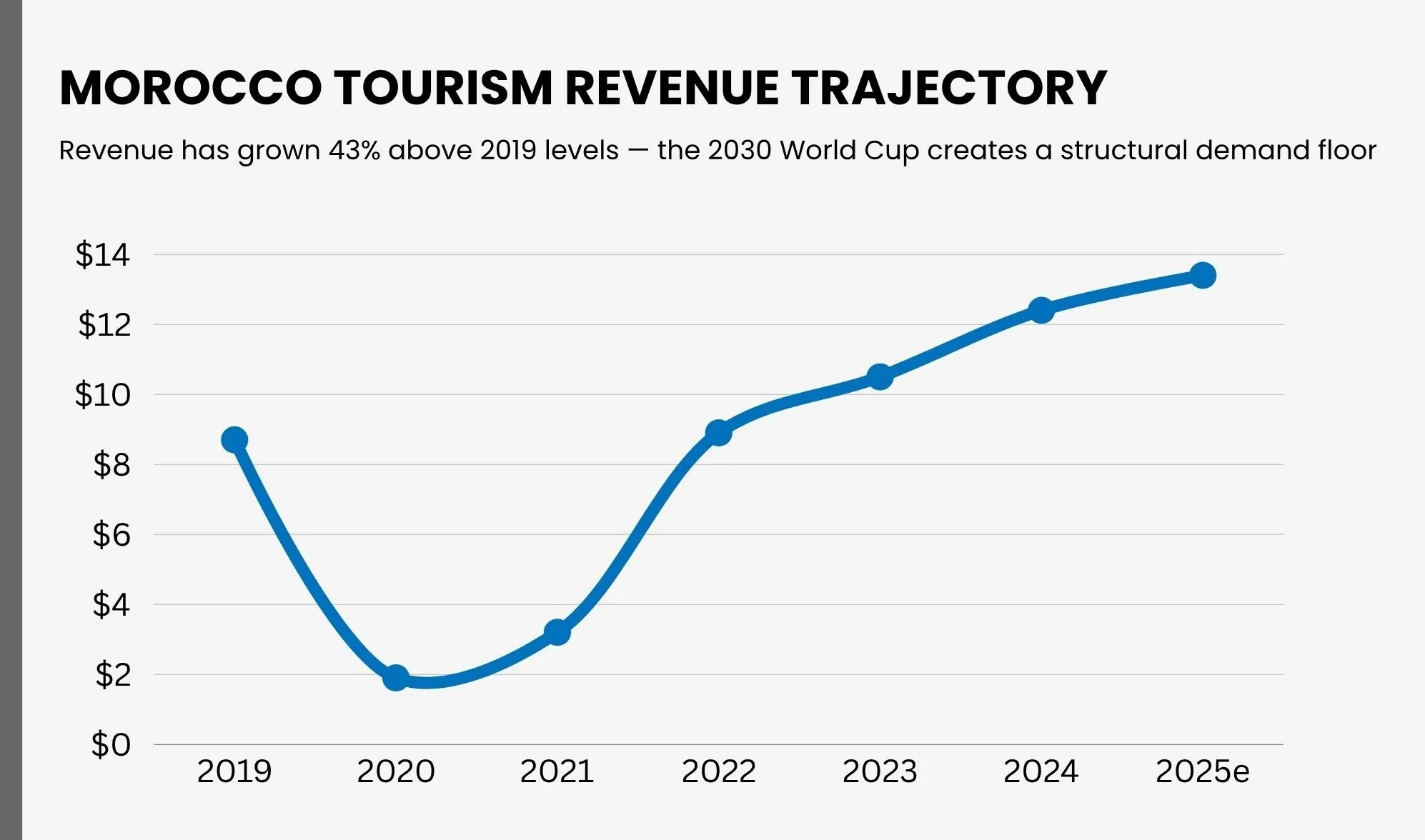
Sources: UN Tourism, Morocco Ministry of Tourism, Morocco Tourism Observatory
Each additional million visitors arriving with digital-first expectations is a cohort of potential customers looking for businesses that are findable, bookable, and credible online. The businesses that are positioned to capture that spend in 2026 and 2027 are not the ones that register a domain in 2028.
Why recommendation culture is a ceiling, not just a foundation
There is a reason so many Moroccan businesses are profitable without a working website: recommendation networks are genuinely effective here. A riad fills its rooms through repeat guests and agency relationships. A clinic builds a patient base through doctor referrals. A restaurant survives on neighbourhood loyalty and word of mouth passed through family networks. This is not a failure of ambition. It is a rational response to a market where personal trust has historically been the most reliable signal of quality.
The problem is that recommendation networks have a natural ceiling. They reach the people who already know you, or know someone who knows you. They do not reach the tourist who lands in Marrakech for the first time with no local contacts. They do not reach the procurement manager in Brussels who is vetting Moroccan suppliers for a logistics contract. They do not reach the expatriate family relocating to Casablanca who is choosing a paediatrician online before they arrive.
AFCON 2025 proved the point in real time
The argument does not have to be theoretical. Morocco hosted AFCON 2025 between December 2025 and January 2026, and the event generated a measurable digital demand spike that most Moroccan businesses were structurally unprepared to capture.
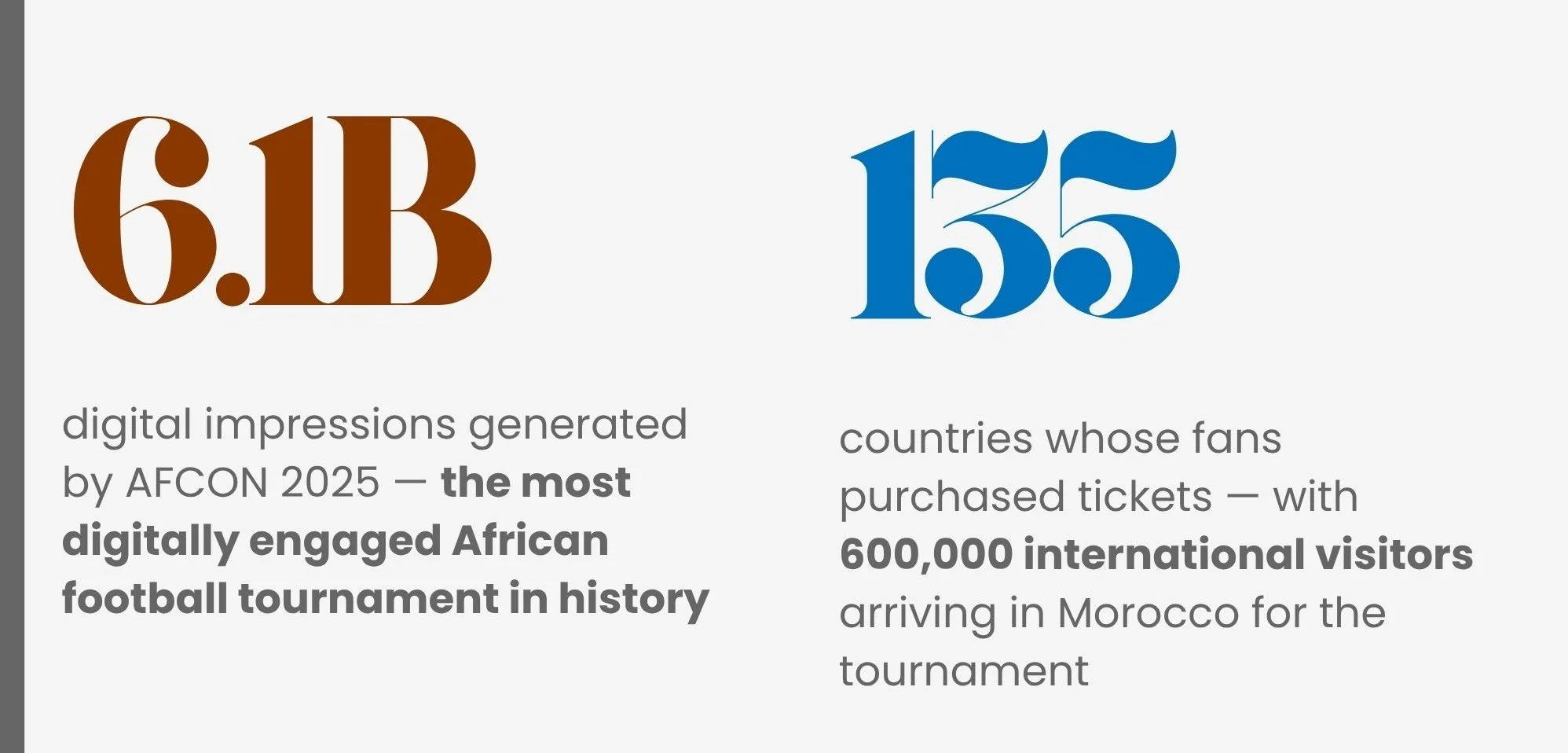
According to CAF's post-tournament data, AFCON 2025 generated 6.1 billion digital impressions and 5.2 billion video views across social media platforms, making it the most digitally engaged continental football competition in history. The tournament attracted fans from 135 countries, sold over 800,000 tickets, and brought approximately 600,000 tournament-specific international visitors to Morocco.
The global broadcast footprint expanded dramatically. CAF reported a 61% global audience surge and a 50% increase in international broadcast partners compared to the 2023 edition — with first-time deals in Japan, South Korea, China, Mexico, and Colombia. Germany recorded an all-time high AFCON audience of over 4 million viewers. CAF's commercial revenues increased by more than 90% on the previous edition.
On the ground, the economic effect was direct. Commercial sectors in host cities reported consumption increases of 25–30% during the tournament period. Marrakech hotels, already strong from the pre-tournament tourism wave, saw occupancy accelerate sharply as the competition schedule intensified. TikTok alone recorded over one million videos created under the official tournament hashtag, each one a piece of organic content driving global attention toward Morocco as a destination.
What this means for businesses
Every one of those 600,000 international visitors was searching for restaurants, accommodation, guides, and services online before and during their stay. The businesses that captured their attention and their spend were the ones that were findable — with a working website, a Google Business profile, a booking mechanism, and content in the right language. The ones operating on referral networks alone were invisible to this audience. AFCON was a preview. The 2030 World Cup — which Morocco co-hosts with Spain and Portugal — will bring a demand spike an order of magnitude larger, with audiences that are even more digitally native and even less likely to ask a local for a recommendation.
The free platforms case
Many businesses that recognise this have taken a partial step: an Instagram account, a Facebook page, a Google Business profile. These are not nothing. A strong Google Maps presence gets you found in local searches. Instagram builds brand recognition. But they are not sales infrastructure. You cannot take a booking on Instagram. You cannot communicate your pricing, your services, or your availability in three languages on a Facebook page. You cannot capture a lead from a visitor who found you on Google Maps but had no website to land on. Free platforms are useful for visibility. They are a poor substitute for a channel you own and control.
The government has already made the case — the question is timing
Morocco's Digital Morocco 2030 plan commits USD 1.1 billion to digital infrastructure and explicitly targets the transition of Moroccan businesses to digital-first operations. The 2030 World Cup co-hosting role accelerates this: international visitors at that scale require digital booking infrastructure, multilingual communication, and online payment capability as a baseline expectation, not a differentiator.
The government incentive is real, the infrastructure investment is already underway, and the demand signal — 17 million visitors in 2024, growing — is unambiguous. What this creates is a specific window. Businesses that build their digital sales channel now are ahead of a wave that will eventually close the gap for everyone. Businesses that wait until 2029 are building infrastructure after the demand has already been captured by whoever was there first.
The moment
The combination of Morocco's tourism growth, its government's digital investment commitment, and the current under-indexed state of business digital presence creates an unusual situation: the market is demanding digital capability faster than local businesses are building it. The businesses, and the international companies partnering with them, that move now are not just catching up. They are establishing a position before the rest of the market arrives.
This conversation is already happening
The argument being made here is not contrarian. It is a ground-level articulation of something that those funding and governing Morocco have already concluded.
The Moroccan government has acknowledged the gap directly. Its Go-To-Market programme, launched in 2023, explicitly targets digital platforms as the mechanism for unlocking untapped export potential, recognising that Morocco's commercial output consistently exceeds its digital visibility. Separately, the Moroccan National Tourism Office commissioned an international agency consortium in December 2025 to strengthen Morocco's digital presence across 16 global markets. The destination is being promoted digitally. The businesses within it largely are not.
Investors have drawn the same conclusion. TravelTech captured 53% of all Moroccan startup funding in 2024, driven by Nuitée's $48 million Series A, a B2B hospitality platform built on the premise that Morocco's accommodation sector is structurally under-digitalised. The single largest startup bet in Morocco last year was a direct wager on closing the hospitality digital gap.
LaunchBase Africa noted that Morocco's tourism boom is driving parallel expansion in tech infrastructure, with Technoparks being built specifically to support the digital businesses the visitor economy demands. And analysts at Modern Diplomacy have described Morocco's central tension as a "two-speed" economy: world-class infrastructure and governance at the top, informal and under-digitalised at the SME level. That gap is precisely where the tourism opportunity lives, and precisely where it goes uncaptured today.
Reading the gap correctly
It would be easy to read the 51% active website figure as evidence that Morocco is not ready for international business. That reading is wrong. It is evidence of a specific structural lag, one that is actively closing, and that creates short-term opportunity precisely because it exists.
Morocco's regulatory environment for digital business is sophisticated by regional standards. Its internet infrastructure is the best on the continent. Its consumer market is digitally engaged. The lag is concentrated at the SME operational level: the clinic that registered a domain but never built a site, the restaurant group that has 40,000 Instagram followers but no booking integration, the accountancy firm that handles multinational clients but has a 2017 website with a broken contact form.
These are not businesses that need to be convinced of the value of digital presence. They have already made that decision. What they need is the execution: in the right languages, for the right audience, built to the standard that international visitors and partners now expect as a baseline.
Where Sorato operates in this market
Sorato Digital is a Casablanca-based digital operations company working at the intersection of this gap. We work with Moroccan businesses building the digital presence they have already decided they need, and with international companies establishing themselves in the market who want to understand and operate within the local digital contextnot build something that works in Europe and hope it translates.
The tourism growth curve is real and it is accelerating. The businesses that will capture the spend of 19 million visitors in 2025, and 26 million by 2030, are the ones that are findable when those visitors are researching. That is a straightforward operational problem. It has a straightforward solution. The window to get ahead of it is now, not in 2028 when the World Cup infrastructure is finished.
Entering Morocco? Let’s talk about what digital presence actually means here.