Half of Morocco's Registered Domains Lead Nowhere. We Got Curious - And Started Digging.
A news article about Morocco's telecom growth revealed a quietly striking statistic about .ma domains. So we pulled the historical data, compared it across Africa and Europe, and found something worth writing about.
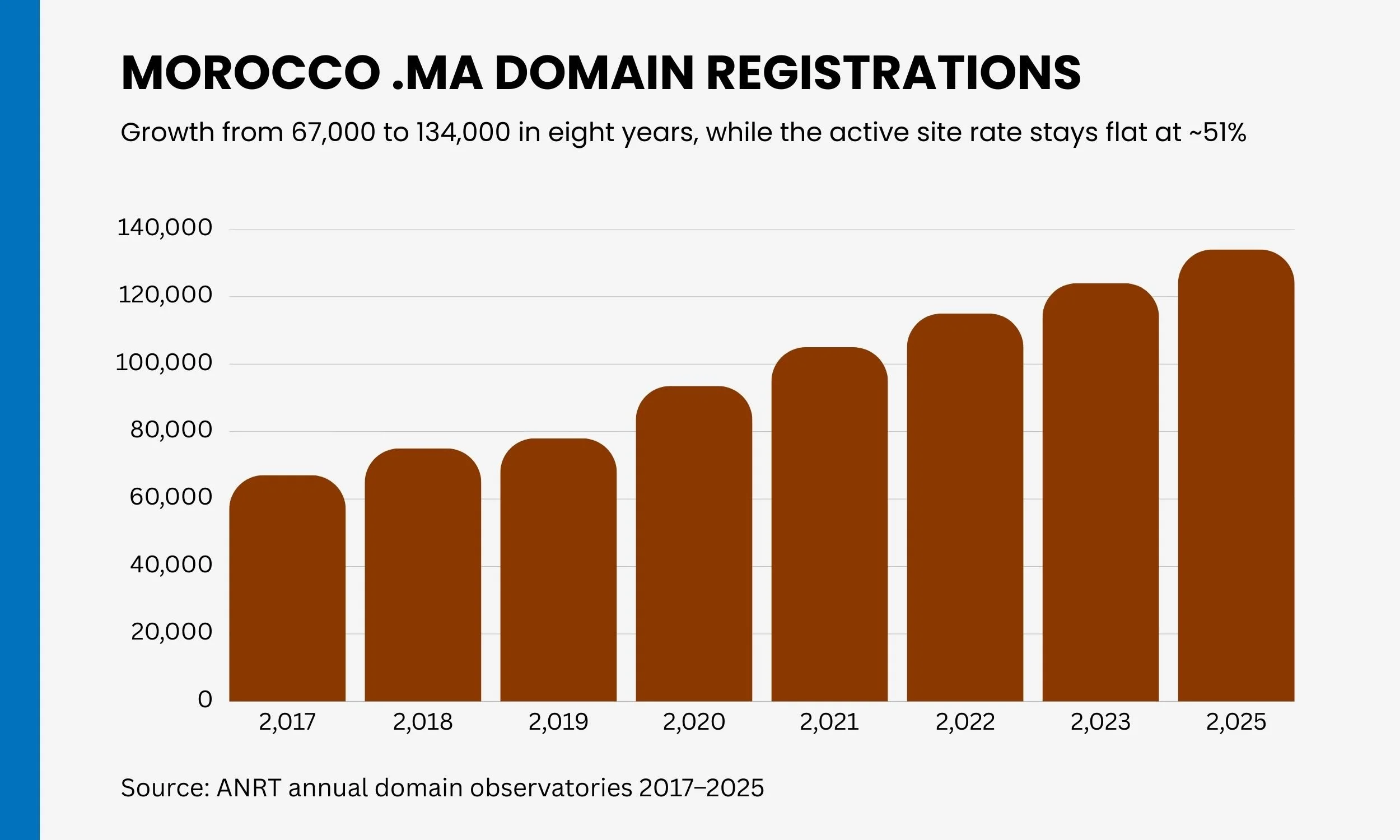
It started with a Morocco World News article covering the latest ANRT quarterly report. Among the headlines about 5G rollout and declining SMS volumes, one line caught our attention: Morocco's .ma domain registrations had reached nearly 134,000 by the end of 2025, growing 8.1% in a year. Good news for digital adoption. But buried in the same regulator's historical data was a figure that told a different story. We went looking for it, and found it had barely moved in six years.
Just over half of all registered .ma domains are associated with an active website. Roughly 65,000 Moroccan businesses and individuals registered a domain, paid for it annually, and built nothing. Or built something, let it go inactive, and kept renewing the address anyway.
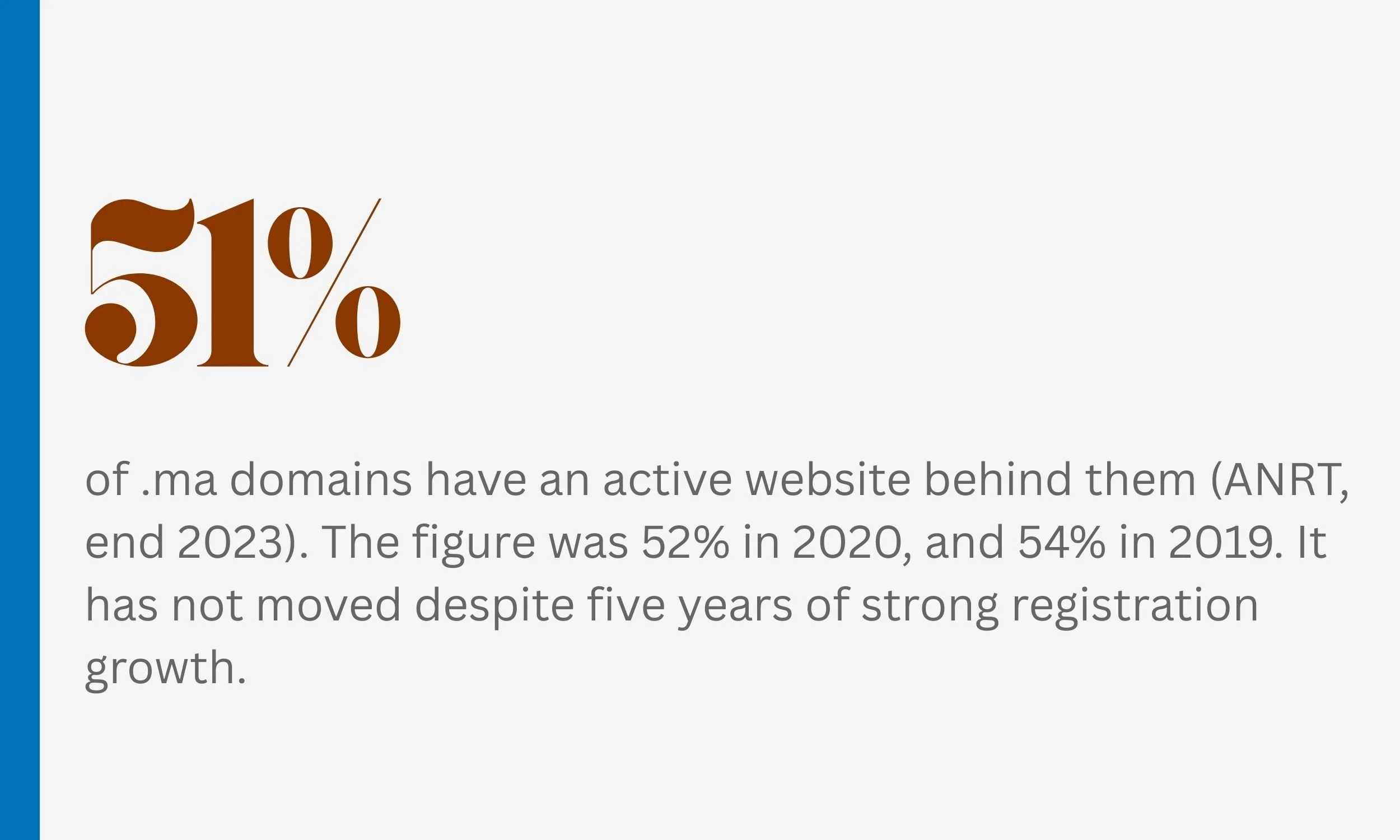
The numbers keep growing. But the ratio of intent to execution has barely shifted. More businesses are claiming space online. Roughly the same proportion are actually showing up there.
What makes this data remarkable
Before getting into what the numbers mean, it is worth pausing on the fact that they exist at all. Most domain registries around the world track registrations, renewals, and deletions. Very few go to the effort of auditing whether anything is actually running at those addresses.
ANRT does. Its annual domain name observatory has tracked this active website rate every year since 2017. It is published openly, in detail, alongside renewal rates, domain ages, registrant locations, and DNS configuration data. For an African regulator, this level of transparency is genuinely unusual. It signals that ANRT treats domain registrations as a means to an end, not a headline number to maximise.
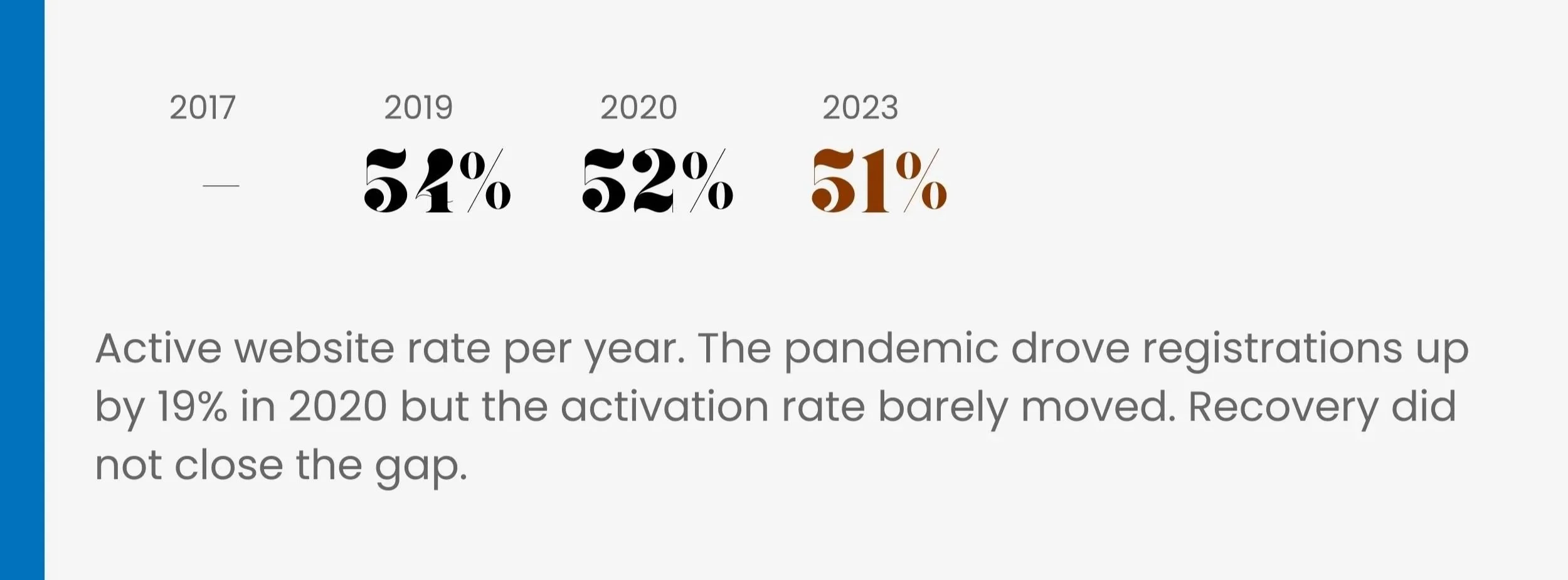
Most analysis of Morocco's digital growth stops at registration numbers. ANRT's data allows a more honest question: are those registrations actually translating into digital presence? The answer, consistently, is: about half the time.
How Morocco compares
To contextualise this, we looked at what equivalent data exists for other countries. The comparison is revealing, but not in the way you might expect.
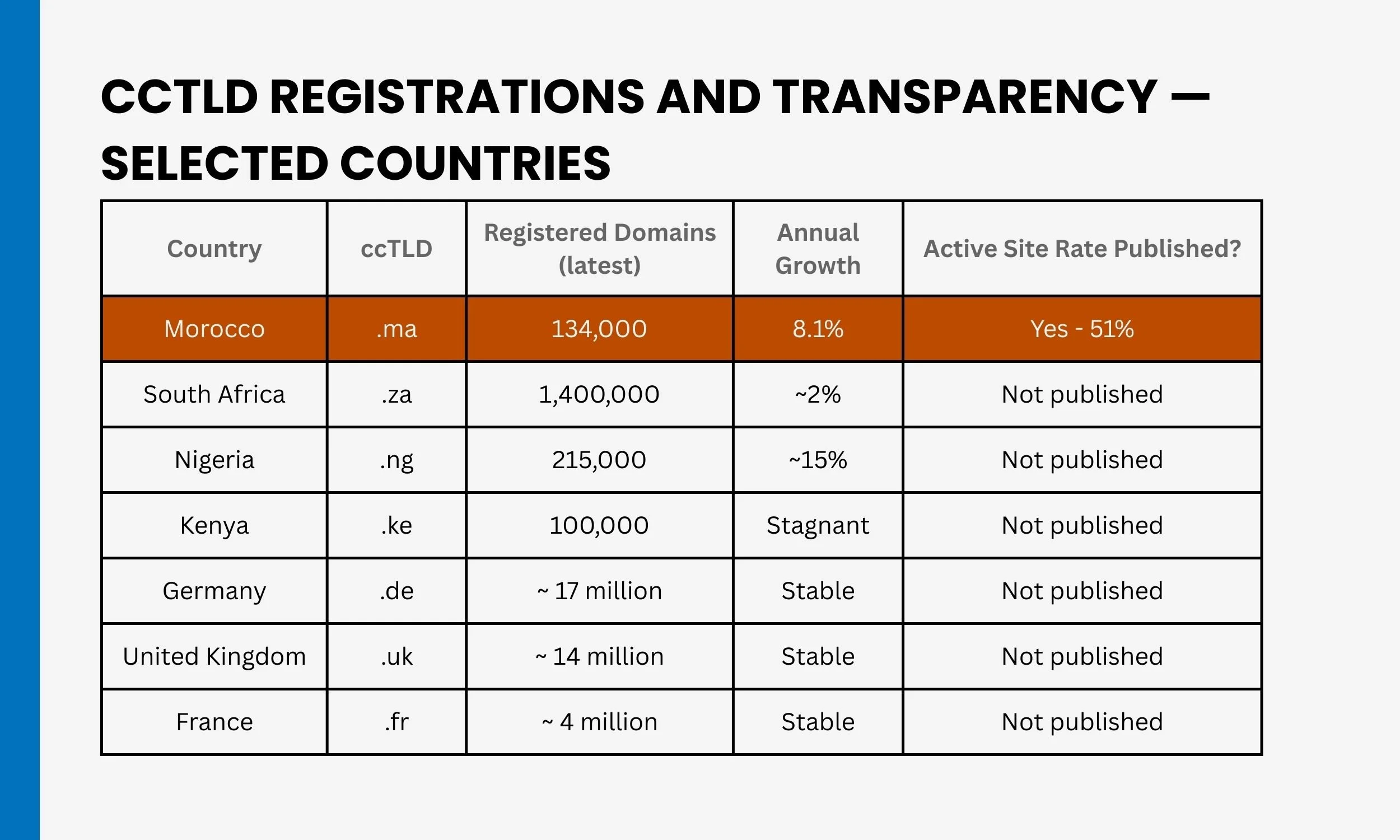
The absence of active site data across the rest of the table is not a gap in our research. It is the actual situation: South Africa's ZARC, Nigeria's NiRA, Kenya's KeNIC, and the European registries all publish volumes and renewal rates but do not track whether a functioning website exists behind the domain. The question is not being asked.
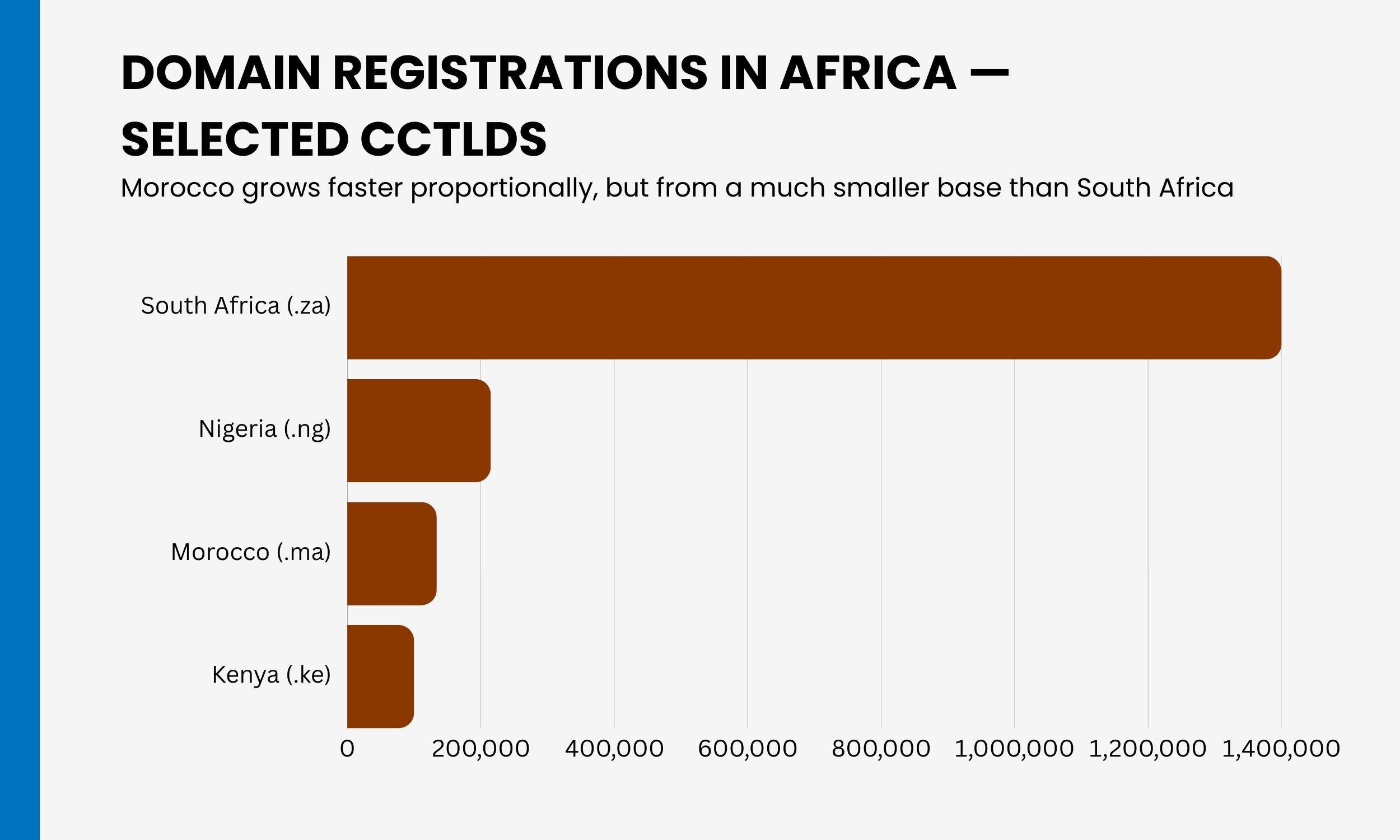
Sources: ZARC, NiRA Q1 2025, KeNIC, ANRT
This matters because it means Morocco is, uniquely among these markets, holding its digital adoption up to scrutiny. The 51% figure would be invisible elsewhere. That institutional honesty is the reason we can have this conversation at all, and it is part of what makes Morocco's digital transition worth watching closely.
What is actually happening here
The 51% figure is easy to misread as evidence of low digital ambition. It is not. It is evidence of a specific friction point: the gap between the decision to go online and the capacity to follow through.
Morocco's internet penetration crossed 112% in 2025, according to the same ANRT report that surfaced this story. The problem is not access. Registering a .ma domain is a low-friction act that any business can complete in an afternoon through an accredited registrar. Building something credible behind it is not: functional on mobile, readable in French and Arabic, with a contact mechanism that actually works and content that gets updated. That requires either skills or budget that many SMEs do not have readily available.
The real constraint
There is also a structural dynamic that most digital adoption analysis misses. In Morocco, the primary trust mechanism in business is personal relationship, not online presence. A clinic, a fiduciaire, a restaurant group — their clients come through referral, family network, and neighbourhood reputation. A website is where the relationship gets verified, not where it begins. So the domain gets registered, satisfies a vague sense of obligation, and then sits idle because nothing in the immediate commercial reality punishes the absence.
The cost, however, is accumulating. And it is increasingly visible to anyone arriving from outside.
The audience that does look at websites
If your clients are Moroccan and your network is local, an inactive website costs you relatively little today. But that calculation is shifting on two fronts.
The first is the 2030 World Cup and the infrastructure investment cycle around it. International companies, procurement teams, and project partners evaluating Moroccan suppliers do check websites. They expect them to be in at least French, functional on mobile, and current. A parked page or an outdated site with a broken contact form is not neutral; it is a signal that the business is not oriented toward external partnership.
The second is the broader shift in how Moroccan consumers, particularly under 35, now research purchases and services. A clinic with no web presence, no booking information, and no visible location is losing patients to one that has those things, even if the clinical quality is identical. The referral network is being augmented by search behaviour, and in some sectors gradually displaced by it.
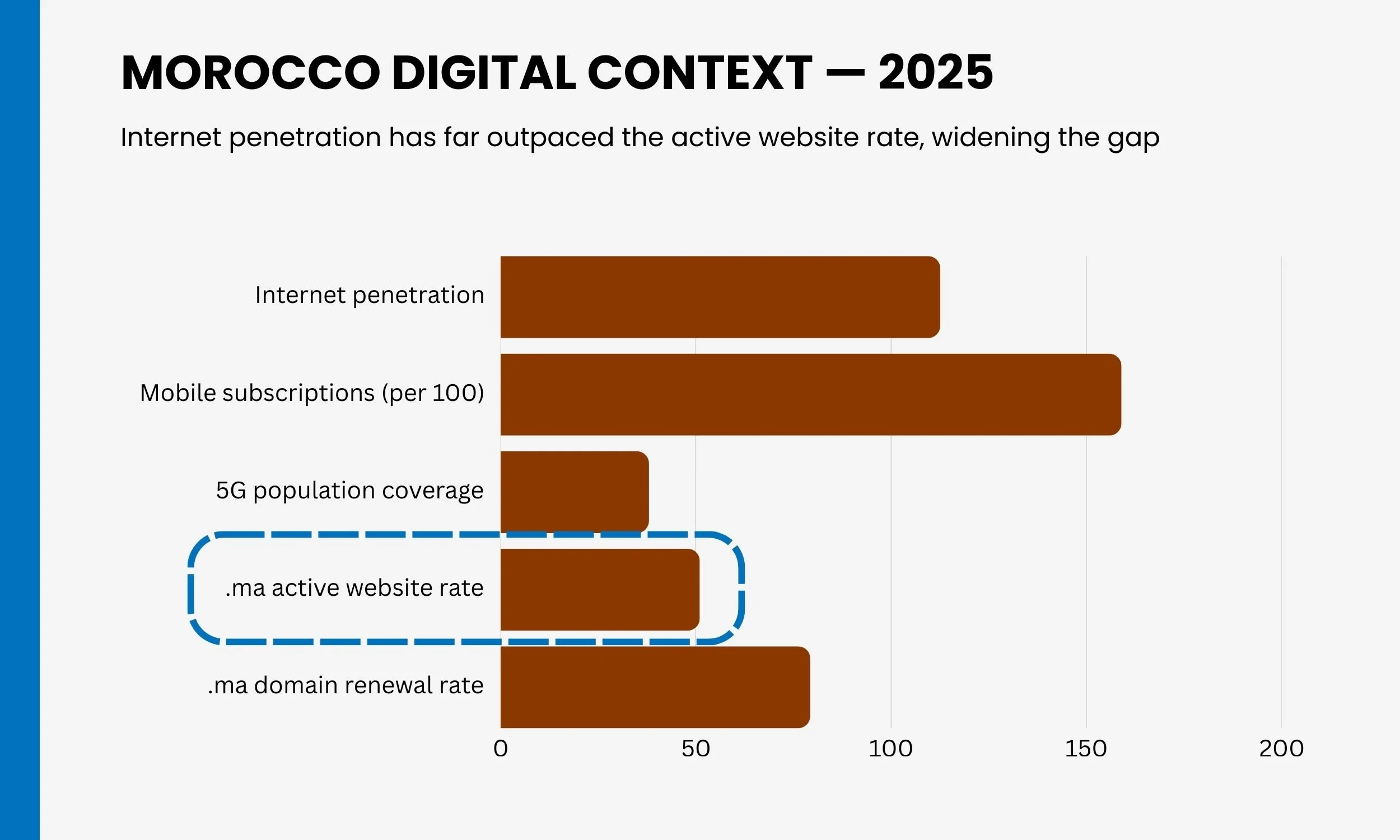
Source: ANRT quarterly telecom observatory, Q4 2025
A note on why this data exists
It is worth sitting with the fact that ANRT publishes this. Most registries do not. The decision to track and report an active website rate alongside registration numbers suggests an institutional view that domain registrations are infrastructure, not vanity metrics. The regulator is asking: are these domains doing anything?
That question has not yet been widely adopted at the business level. The gap between regulatory intent and operational reality is precisely where the work sits.
Why this matters for Moroccan businesses
At Sorato, we work in this gap every day. Not to sell the idea of a digital presence to businesses that have never considered it, but to help the ones that have already started to actually open their digital sales channel.
The domain exists. The decision has been made. What is missing is the execution: a site that works in the right languages, loads on a mobile connection, and converts a visitor into a contact or a sale. That is the difference between a registration and a sales channel.
The obstacle is almost never motivation. It is capacity, prioritisation, and knowing what good looks like in the Moroccan context specifically. A website built without understanding local payment expectations, multilingual dynamics, and mobile-first behaviour is often worse than no website at all.
By that standard, the 51% figure significantly underestimates the real gap. The question is not just whether a website loads. It is whether it works as a channel for the business behind it.
Your domain is registered. Let’s turn it into a sales channel.
Whether you’re a Moroccan business sitting on an inactive domain or an international company establishing a presence in Morocco, we can help you close the gap — in the right languages, for the right audience.
No pitch. Just a conversation about what you’re building.