Your 35% RTO Rate Is Costing You in Euros, Not Dirhams
You are paying for your returns in euros. Here is what that means.
Every Moroccan COD merchant knows their RTO rate. Most have made peace with it. "35% is normal for this category." Fine. But there is one detail almost no one has sat with properly: the cost of that 35% is not denominated in dirhams.
A note before the numbers: RTO cost models vary significantly by market. The one below is built specifically for Morocco — the cost structure, the currency dynamics, and the operational context are all local. Generic e-commerce benchmarks from Europe or the Gulf do not apply here, and we are not trying to make them fit.
Your ad spend is.
The only number that matters
You run Facebook and TikTok ads. Those platforms bill in euros or dollars. Your bank converts at whatever rate the day dictates, then charges a foreign transaction spread on top. By the time that budget hits your ad account, you have already paid a currency premium before a single impression ran.
Now take that budget and divide it by your confirmed orders for the month. That is your cost per acquired order — in hard currency equivalent.
A merchant spending 5,000 MAD on ads and generating 200 confirmed orders has a cost per order of 25 MAD. Sounds reasonable. But 120 of those 200 orders will be delivered. The other 80 will come back.
Those 80 orders still consumed ad budget to generate. The 25 MAD CAC applies to all 200 orders, not just the ones that converted to cash.
The real cost per collected order is not 25 MAD. It is 41.67 MAD — and it is priced in a currency that has been weakening against the dirham for three years.
The model
Three numbers. You know all of them. Plug them into the calculator below — or run the example first to see how the maths works.
Run your own figures. The wasted ad spend number is the one to watch. At 5,000 MAD monthly spend and 35% RTO, you are burning 21,000 MAD per year on orders that never paid out — in a currency you do not earn in.
At 10,000 MAD monthly spend, that figure is 42,000 MAD.
This model isolates ad spend because that is the cost that stings most in the Moroccan context. If you want the full picture — logistics losses, lost revenue, and total monthly impact — use the RTO cost calculator on our website.
The courier reconciliation problem no one talks about
There is a second issue worth raising, though it is harder to quantify: the gap between what your courier invoices and what you can actually verify.
A pattern we hear repeatedly from merchants is that the RTO rate on the courier dashboard and the real operational picture do not always match. The situations that come up most often:
Orders marked "returned" on the portal that the merchant never physically received back
COD cash sitting in courier float for longer than the contract specifies before transfer
Return fees charged on parcels where delivery was, by the merchant's account, never genuinely attempted
Couriers will naturally dispute this framing. We are not in a position to arbitrate. What we can say is that merchants who cross-reference courier invoices against their own order data regularly find discrepancies -- in both directions.
The practical implication is the same regardless: before you optimise your RTO rate, verify that the rate you are tracking is the rate you are actually experiencing. The dashboard number is a starting point, not a confirmed fact.
What a 10-point reduction is worth
Bringing RTO from 35% to 25% on 200 monthly orders and 5,000 MAD ad spend:
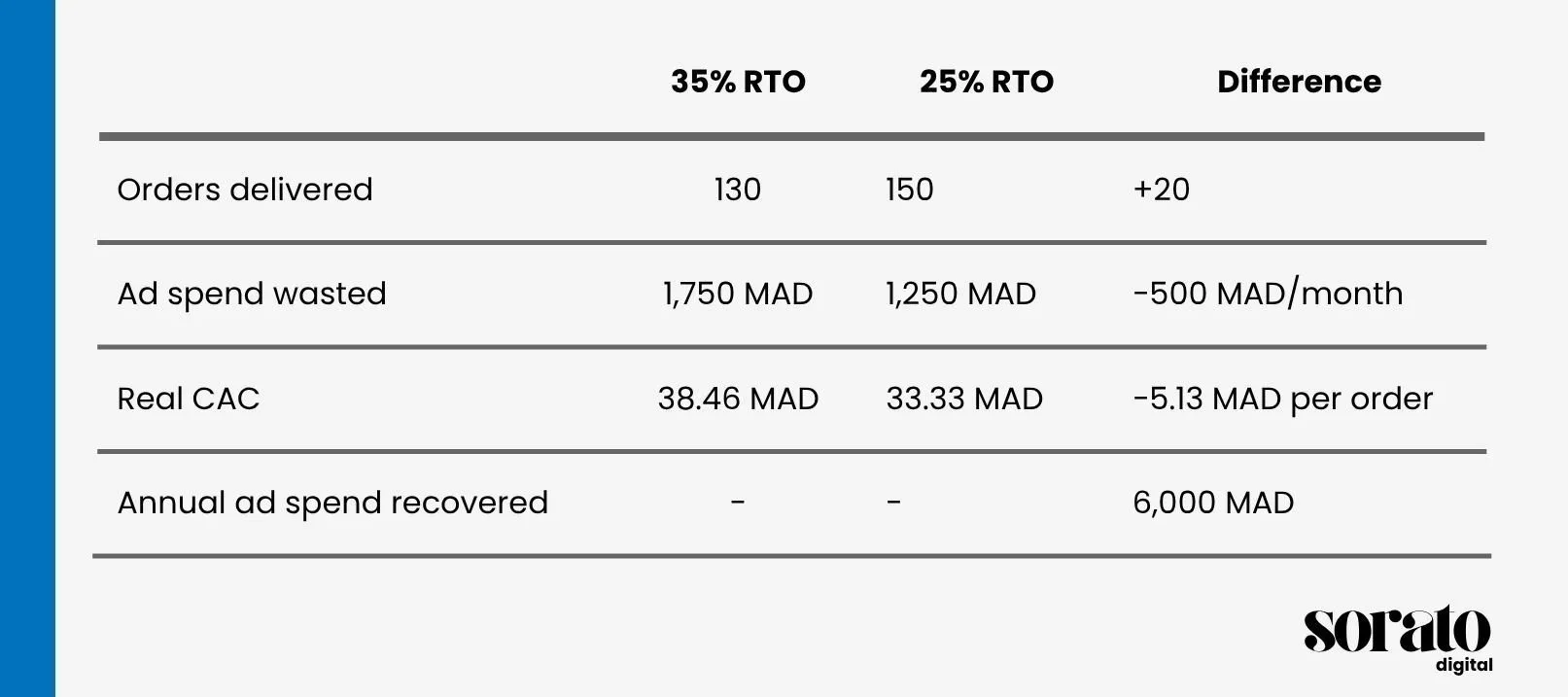
That 6,000 MAD is not saved by spending less. It is recovered by converting more of what you already spend. The ad budget stays the same. The output improves.
Where to start
Two levers move RTO more than anything else in the Moroccan context:
Confirmation quality. A confirmed order that was confirmed badly — wrong address, no response to a voice call, WhatsApp-only without a follow-up — fails at the door. The confirmation step is not a formality. It is the first delivery attempt.
Product-audience fit. A high RTO rate is sometimes a logistics problem. More often it is a signal that the product is reaching people who were never going to pay for it. Tightening targeting, adjusting the offer, or improving the product page reduces RTO at the source rather than at the door.
Courier selection matters less than most merchants believe. The difference between a 35% and a 25% RTO rate almost never lives in which courier you use.
Run the calculator. Then decide if you want to keep paying that number next year. Get the audit →