Return-to-origin is the parcel that leaves your warehouse and comes back undelivered. A Moroccan store running Cash-on-Delivery at a 35% return rate pays to pick, pack, and ship every one of those parcels, pays again for the return leg, and collects nothing on any of them. At that rate a store is rarely 35% less profitable. It is frequently unprofitable outright, because a single returned parcel can erase the margin on several delivered ones.
That is the number every COD operator in Morocco is quietly fighting. This article looks at where the fight is currently being lost, and at the verification layer most stores have not yet built.
The hidden cost of the "add to cart" impulse
Moroccan e-commerce now sits between 22 and 28 billion dirhams and is growing at roughly 25 to 30% a year, one of the fastest expansions in Africa. Cash-on-Delivery still carries more than 70% of those transactions. The customer pays the courier in cash at the door, which removes the trust barrier that card payment would otherwise impose and lets almost anyone buy with a tap.
The same tap creates the problem. A card checkout takes a commitment upfront. A COD checkout takes nothing. The buyer who orders at midnight on Instagram, half-asleep, has committed no money and lost nothing by refusing the parcel three days later. That asymmetry is the root of the ghost order: an order placed with no firm intent to receive it, or one the buyer simply forgets, or one attached to a number nobody answers.
Most stores answer this with a customer service agent who phones each order to confirm it before dispatch. The agent reaches some buyers, misses others, leaves messages, calls back, and works through a queue that grows faster than the team. Confirmation slows to a crawl, buying intent cools while the order waits, and the ghost orders slip through anyway.
Why WhatsApp confirmation is no longer enough
WhatsApp became the standard fix, and for good reason. A message with the product, the exact cash amount, and a request for an explicit "yes" moves confirmation rates from around 60% to the high 80s and cuts returns meaningfully. In Morocco it is now close to a market norm; stores that skip it see return rates markedly higher than stores that send it.
The ceiling shows up on the orders that matter most. A WhatsApp template is a message in a thread, and a message can be left on read. The impulse buyer who ordered without thinking is exactly the buyer least likely to reply to a text asking them to think again. Delayed replies, ignored templates, and the automated-message blindness that regular shoppers develop all concentrate in the same segment: low-commitment, socially-acquired, high-risk orders. WhatsApp confirms your reliable customers efficiently. It does the least for the ones driving your return rate.
A phone that rings is a different demand on attention. It is answered or declined in the moment, and even the decline is a signal.
The mechanics of automated IVR
Interactive Voice Response is an automated phone call driven by keypad input. Applied to COD confirmation, the flow is short and runs without an agent:
An order is placed. Within seconds, the system dials the number on that order.
A recorded prompt plays in Darija or French: "You have ordered [product] for [amount] dirhams. Press 1 to confirm delivery. Press 2 to cancel."
Press 1, and the order is flagged confirmed and released to the courier. Press 2, no answer, or a voicemail, and the order is held rather than shipped, or escalated to a human agent for one deliberate follow-up.
The gain is that confirmation happens in the first minute, while intent is still warm, at a cost of a few centimes per call rather than a fraction of an agent's salaried hour. The call reaches the buyer who would have ignored a text, and the keypad press produces a clean yes-or-no record instead of a "ok 👍" that an agent still has to interpret.
Voice verification pairs naturally with two filters that run before any call is even worth making:
Phone history filter. The number is checked against your own order history. A number that has refused deliveries before, or appears on a shared denylist of serial refusers, is flagged for scrutiny or blocked outright. A malformed number, or a landline where a mobile is required, is caught before dispatch rather than at the door.
Address parsing filter. Addresses that fall outside a courier's coverage zone, or that carry no usable detail beyond a landmark, are surfaced for correction before the parcel is booked with a courier such as Amana or Cathedis. Fixing "near the big mosque" into a routable address at order time is far cheaper than paying for a failed delivery and a return.
Each filter removes a category of order that was always going to bounce, so the calls and the couriers are spent only on orders with a real chance of landing.
Confirming orders keeps you level with the market. Filtering them is how you pull ahead.
Impact on operating margins
The case for automation is a cost curve. Here is the contrast between an agent confirming by phone and an IVR flow doing the same work.
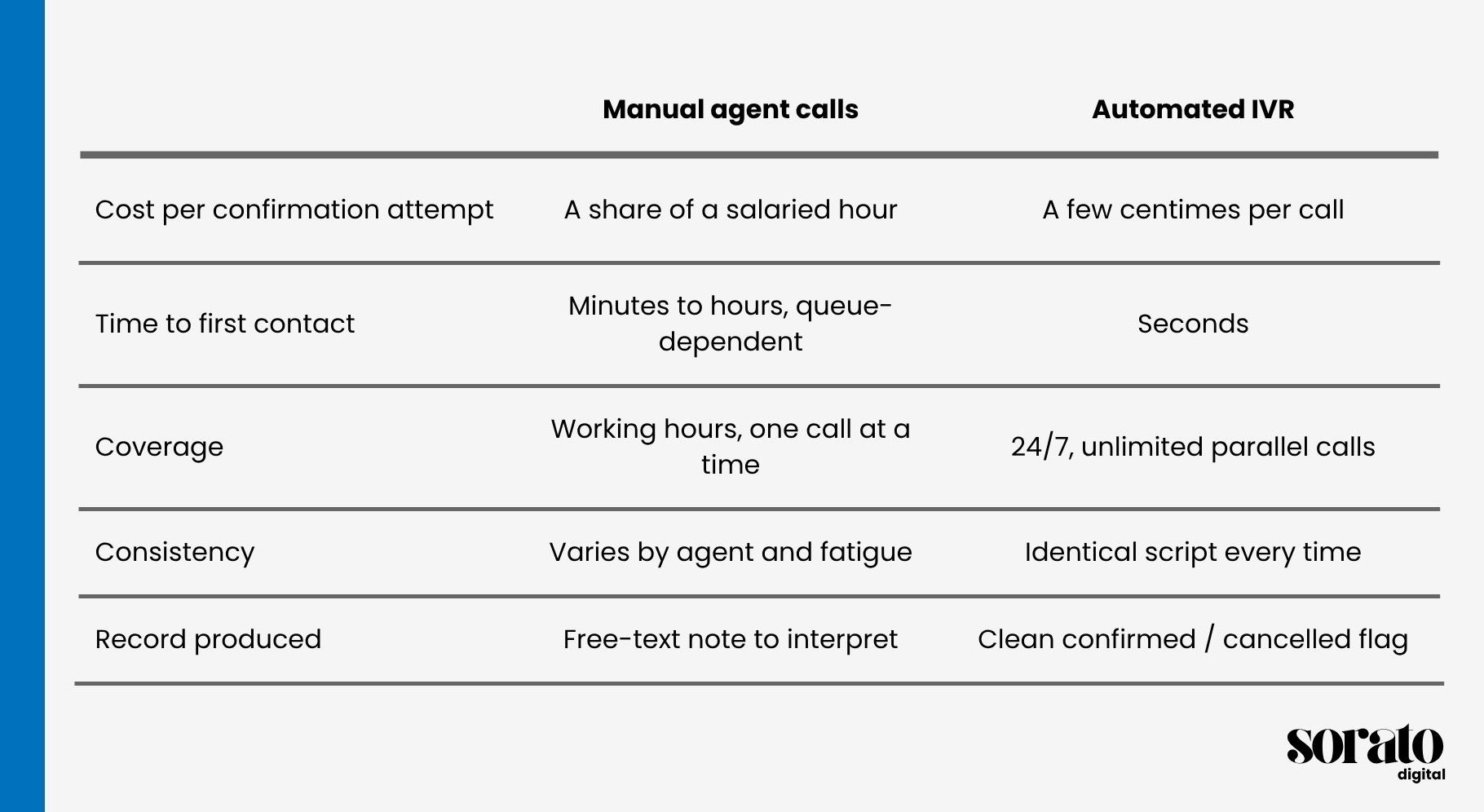
The margin effect is easiest to see through ad spend. Take a store spending 15,000 dirhams a month on Meta ads that generates 300 orders.
At a 35% return rate, 195 of those orders actually deliver. The advertising cost carried by each delivered order is 15,000 divided by 195, roughly 77 dirhams.
Pull the return rate down to 15%, and 255 orders deliver. The same ad budget now spreads across more paying customers: 15,000 divided by 255, roughly 59 dirhams per delivered order. That is a 23% cut in effective acquisition cost from the same spend, before counting the return-shipping and handling fees saved on the 60 parcels that never left the warehouse.
Reducing RTO from a typical 30 to 40% down toward 15% is not a customer-service improvement at the edge of the business. It is the difference between advertising into a leaking funnel and advertising into a sealed one.
Verification is a workflow before it is a piece of software: the right filter running at the right moment, feeding the courier only the orders worth its time. Building that workflow around your own store, your own courier mix, and your own return patterns is where the return-rate gains actually come from.
Sorato builds and implements these pre-shipment order filtering systems for Moroccan COD merchants. See how we implement order verification for digital platforms.